
An EGD, also known as an upper GI tract endoscopy, is a procedure that uses a lighted, flexible endoscope to see inside the upper GI tract. The upper GI tract includes the esophagus, stomach, and duodenum—the first part of the small intestine. This procedure can be used to remove stuck objects, including food, and to treat conditions such as bleeding ulcers. It can also be used to biopsy tissue in the upper GI tract to check for conditions such as Celiac disease, and determine the causes of abdominal pain, nausea, vomiting, anemia, acid reflux or swallowing difficulties. Before the procedure, you will need to follow prep instructions given to your physician which you need to follow carefully. During the procedure, you will receive IV sedation then the endoscope with a small camera inserted down the esophagus and into the stomach and duodenum. Images are viewed on a screen, allowing examination of the intestinal lining. Biopsies may be taken, which are sent to the lab for testing. As with any procedure, the risks are small but can include perforation in the stomach, duodenum or esophagus and bleeding from the biopsy site. After your procedure, you generally can resume a normal diet but you are not allowed to drive after the procedure due to anesthesia. You will need someone to drive you to and from the center. You will be notified of your biopsy results in 1-2 weeks.
What to Expect Before, During, and After an Upper Endoscopy (EGD)
Before the Procedure
Before an upper endoscopy, your care team will provide instructions to help ensure a safe and effective evaluation. This usually includes fasting for a specific period of time and temporarily adjusting certain medications if needed.
Following preparation instructions carefully helps improve visibility during the procedure and allows your provider to examine the upper digestive tract more accurately.
During the Procedure
When you arrive, your care team will guide you through the process and answer any questions. Most upper endoscopies are performed with sedation to help you remain comfortable.
During the procedure, a thin, flexible tube with a camera (endoscope) is used to examine the esophagus, stomach, and upper portion of the small intestine. The procedure is generally well-tolerated, and your care team monitors you throughout.
After the Procedure
After the procedure, you will be monitored briefly while sedation wears off. You may experience mild throat discomfort or bloating, which typically resolves quickly.
Most patients go home the same day and can return to normal activities shortly after, depending on their provider’s guidance. Your doctor will review initial findings and discuss any next steps if needed.
Common Questions About Upper Endoscopy (EGD)
Is an upper endoscopy painful?
Upper endoscopy is typically performed with sedation, so most patients feel little to no discomfort during the procedure.
How long does the procedure take?
The procedure itself is usually brief, though total visit time includes preparation and recovery.
Are there risks?
Upper endoscopy is considered a safe and routine procedure. Your provider will review any potential risks and considerations based on your health history.
Will I need time off work?
Because sedation is commonly used, patients usually take the rest of the day to recover and resume normal activities the next day.
What is WATS-3D?
We offer WATS3D, an advanced technology that can be used during an upper endoscopy. WATS3D uses a specialized brush to collect additional tissue samples, helping improve the detection of Barrett’s esophagus and precancerous cells when used alongside standard biopsies.
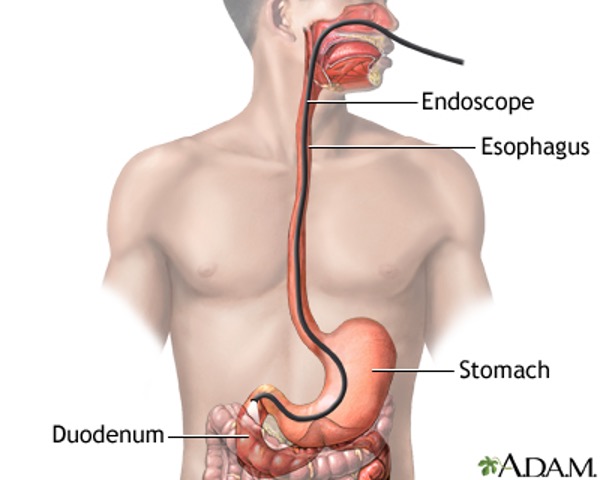
Image courtesy of Medline Plus
Reference:
Medline Plus-National Library of Medicine. 2023. EGD. https://medlineplus.gov/ency/article/003888.htm